Under the trend of "dual carbon", how to build a zero-carbon data center should focus on "where does the electricity come from?" Where is it hot?" (3)
Publication Date:2024-12-16
Share to
3. Application of liquid cooling technology scheme
Innovative technology is the core driving force to promote energy conservation and carbon reduction in data centers, the innovation of cooling methods, and the optimization of design and construction methods. In the field of data centers, the number of servers determines the business processing capacity of the entire data center, while medium and large data center servers are calculated in thousands, and 10 servers are placed in a rack, and a large data center needs hundreds of racks. Such a huge amount of server equipment running at the same time, calculated according to the operating power of 300W per unit, 10,000 units will cost 3 megawatts, so if each server can save a little energy consumption, the energy consumption saved by 10,000 servers is very considerable. Therefore, many experts start from the server, work the server, and try to reduce the energy consumption of the operation and improve the operating environment of the server without reducing the operating performance of the server. Compared with the volume of air and water, such as 1 cubic of water and air, when the temperature changes by 1°C at room temperature, the heat transfer of air is about 1.3 kilojoules, and the heat transfer of water is about 4200 kilojoules, which shows that the heat transfer capacity of water exceeds 3000 times that of air.
At present, liquid-cooled data centers in our country are still in a stage of rapid development, but some large enterprises and institutions have begun to try to deploy liquid cooling technology, such as Alibaba, Tencent, Huawei and other companies are building or transforming some data centers into liquid-cooled data centers. In addition, some startups are also exploring and practicing in the field of liquid cooling, such as Yunku Intelligence, Green Yuntu, Yimikang, Haiwu, Shenling, etc.
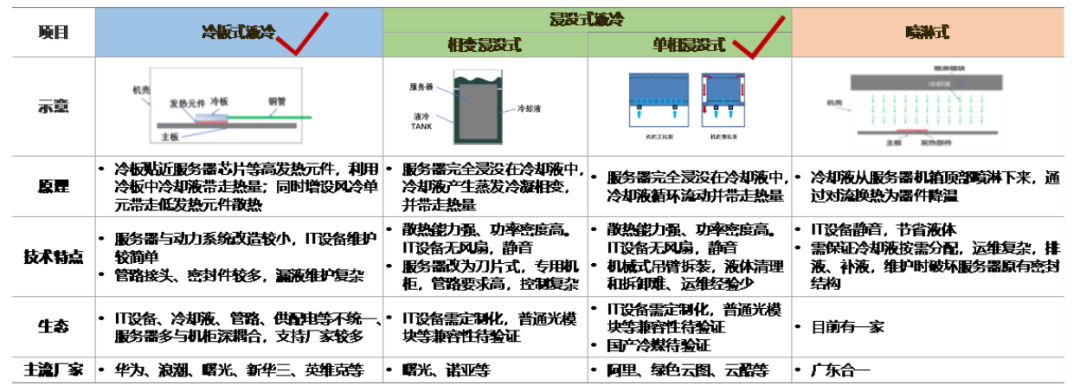
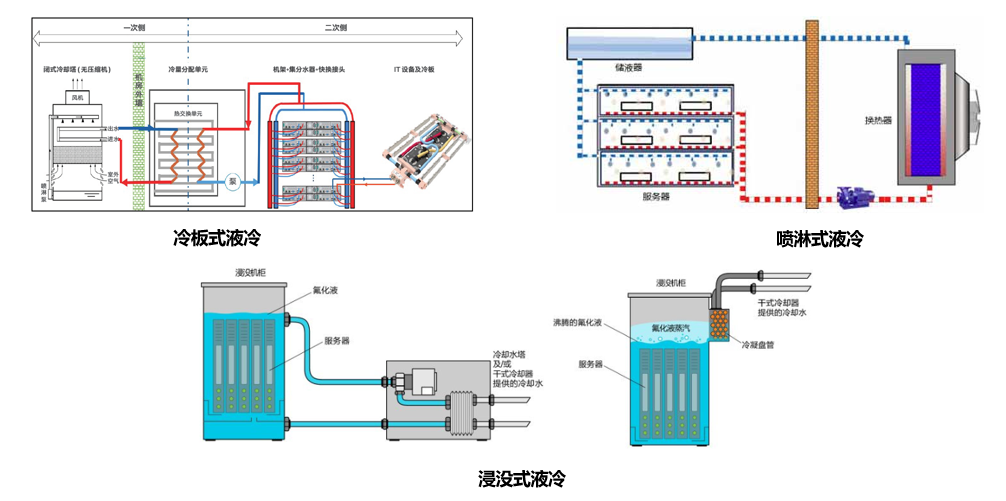
At present, there are three main categories of liquid cooling technology, namely spray liquid cooling, immersion liquid cooling, and cold plate liquid cooling, and the schematic diagram is as follows:

1. Spray liquid cooling: Spray coolant on the cooling elements of the server by spraying to remove the heat generated by the server.
2. Immersion liquid cooling: A cooling system that completely immerses the heating components of the server in the coolant and takes away the heat of the server through the convection or phase change of the coolant. According to the current mainstream fluoride solution, the single-phase heat exchange capacity of fluoride liquid is more than 1200 times that of the same volume of air. If the phase change immersion type is adopted, the phase change heat transfer capacity of the fluorinated liquid is more than 10,000 times that of the same volume of air.
3. Cold plate liquid cooling: Liquid cooling cold plate heat dissipation is used for large-power components such as CPU in servers, and air cooling systems are still used for other heat-generating devices (such as hard disks, interface cards, etc.). The advantage of cold plate liquid cooling is that it has little impact on the architecture of the existing computer room, and the heat dissipation capacity of water is 3200 times that of the same volume of air, and it has the characteristics of low noise, high space utilization and heat energy recovery.
According to the research data of CCID Prospective Industry Research Institute, the market size of our country's liquid cooling market in 2022 will be about 60 billion yuan, of which the market share of cold plate liquid cooling will account for about 65%, and the submersible liquid cooling will account for about 34%, and the liquid cooling market size of our country will increase to 80 billion yuan in 2023, and the liquid cooling market size of our country is expected to reach about 130 billion yuan by 2025.
In 2018, Alibaba built a large-scale immersion liquid-cooled Zhangbei data center, which is Alibaba Cloud's first data center to apply a fully immersion liquid-cooled server, which has a heat conduction efficiency of 100 times higher and an energy saving effect of more than 70% compared with traditional refrigeration systems. Alibaba Zhangbei liquid-cooled data center not only has technological innovation and leading edges, but also pays attention to environmental protection and energy saving. The data center uses advanced energy-saving technologies such as natural cooling to control the power utilization effectiveness (PUE) within 1.25 and as low as 1.13.
The advantage of immersion liquid cooling technology is not only heat conduction and heat dissipation, but also the ability to accommodate more IT equipment and improve computing power. The power density of Alibaba Zhangbei liquid-cooled data center reached 60 kilowatts, increasing the computing density by 10 times. At the same time, the liquid-cooled cabinet has the characteristics of high sealing, which keeps electronic components away from the influence of humidity, dust and vibration, improves the stability of the equipment and reduces the incidence of failure. In the past three years of operation, the failure rate of Alibaba Zhangbei liquid-cooled computer room has been reduced by 54% compared with other computer rooms of the same size. Based on Alibaba's experience with Zhangbei liquid-cooled data center, in 2020, Alibaba built China's first 5A-level liquid-cooled data center in Hangzhou - Alibaba Hangzhou Renhe liquid-cooled data center, which uses fully immersed liquid-cooled servers in the entire building. Due to the large-scale use of fully immersion liquid-cooled server technology, the overall PUE value is 1.09, which is currently the world's leading level.
On June 5, 2023, the three major operators of China Mobile, China Unicom and China Telecom released the "White Paper on Liquid Cooling Technology for Telecom Operators" at the "Computing Power Innovation and Development Summit Forum" of the 31st China International Information and Communications Exhibition, which analyzed the current situation faced by data centers and the development status of liquid cooling technology, introduced the practice and current development challenges of liquid cooling technology of telecom operators, and put forward the three-year vision and specific technical route for the development of liquid cooling technology of telecom operators. The selection of two key technologies of cold plate type and immersion liquid cooling is introduced. On the whole, cold plate liquid cooling and single-phase immersion liquid cooling have their own advantages and disadvantages, and the ecology needs to be improved, and the evolution of both will take time, and will coexist and develop in a certain period of time in the future, which is the mainstream of development in the current industry. In summary, telecom operators are currently promoting two technical routes: cold plate liquid cooling and single-phase immersion liquid cooling, as detailed below:

According to the White Paper on Liquid Cooling Technology for Telecom Operators, it is expected that more than 50% of data center projects will use liquid cooling technology by 2025. Liquid-cooled data centers in the Internet industry account for 24.0%, the financial industry accounts for 25.0%, the telecommunications industry accounts for 23.0%, and the energy industry accounts for 10.5%.
The emergence of liquid cooling technology not only contributes to the "dual carbon" strategy, but also promotes the implementation of new energy-saving technologies in data centers, improves the heat dissipation form of traditional air cooling, and can better meet the needs of high-density cabinets, chip-level precise cooling, more energy-saving, more land-saving, and lower noise.
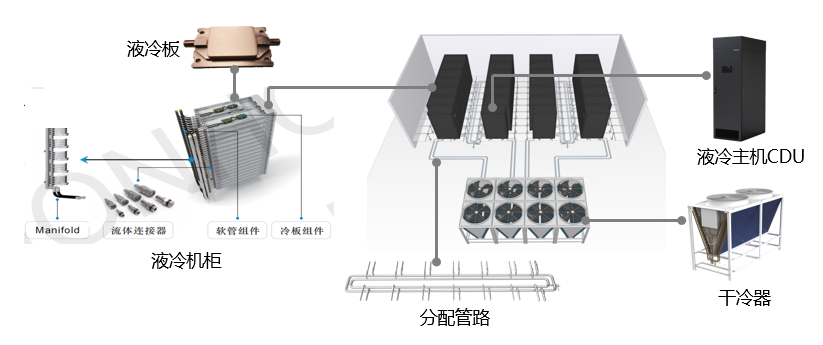
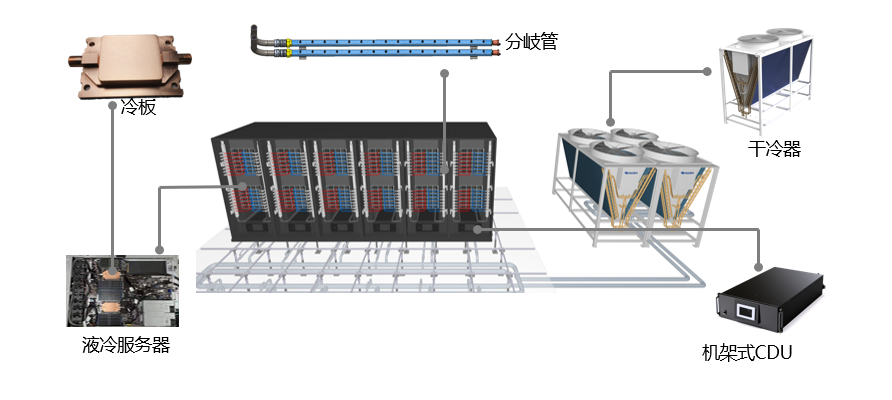
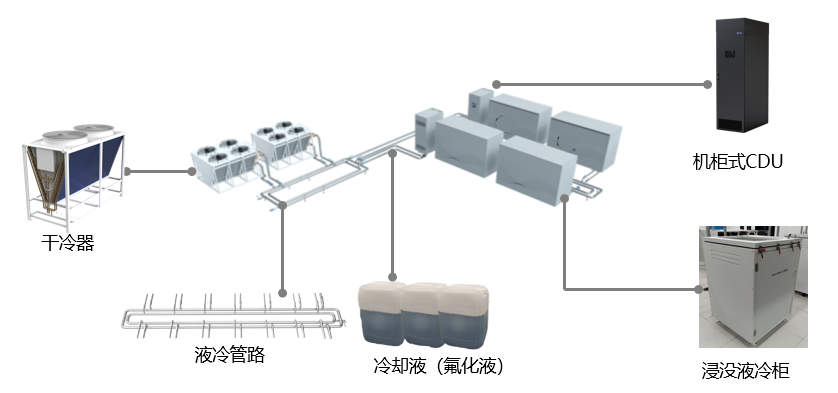
In the actual data center scenario application, the liquid cooling solution is combined with different products to formulate scenario-based solutions, such as Haiwu's scenario-based liquid cooling solution, namely:
Scenario 1: Using cold plate liquid cooling, with centralized CDU solution, the maximum power density supported by this solution is 50~80kW, and the average annual PUE of the overall liquid cooling solution can be 1.2 and below.

Scenario 2: This scheme adopts cold plate liquid cooling, with distributed CDU scheme, the maximum supported power density of this scheme is 50~80kW, and the average annual PUE of the overall liquid cooling scheme can also be 1.2 and below.

Scenario 3: This solution adopts single-phase immersion liquid cooling, outdoor dry cooler, and dual cabinet CDU, with a maximum supported power density of 30~100KW, and the average annual PUE of the overall liquid cooling scheme can be 1.1 and below.

At present, the solutions of various liquid cooling equipment manufacturers are different, because the current ecology of liquid cooling technology is not perfect, the product forms are different, the degree of product standardization is low, the cabinet and the server are deeply coupled, and there is no unified interface standard, which is difficult to standardize and promote and apply on a large scale. To promote liquid cooling technology, it is necessary to brainstorm and build consensus, improve the standardization and ecological construction of the liquid cooling industry, promote the orderly development of liquid cooling technology, and open up a high-quality development path for the data center liquid cooling industry.
Related Newsmore