Under the trend of "dual carbon", how to build a zero-carbon data center should focus on "where does the electricity come from?" Where is it hot?" (4)
Publication Date:2024-12-16
Share to
4. Application of heat recovery scheme
With the advancement of the "dual carbon" policy, more data center practitioners have focused on the waste heat of the data center, which is a high-quality heat source that can be used to heat domestic water and heating, and can indirectly reduce carbon dioxide generated by the use of fossil fuels while helping users reduce heat costs. According to existing data, the total recoverable waste heat of data centers in our country's northern region is about 10GW, which can theoretically support 300 million square meters of building heating. At present, some large data centers have adopted data center waste heat recovery technology, such as Alibaba Qiandao Lake Data Center, Tencent Tianjin Data Center, China Telecom Chongqing Cloud Computing Base, GDS Beijing No. 3 Data Center, and Ucloud Ulanqab Cloud Computing Data Center. The use of waste heat recovery technology for heating and hot water in the park can not only reduce energy consumption, but also reduce the operating costs of the data center, which can be described as killing two birds with one stone.
At present, the main schemes of waste heat recovery include the following:
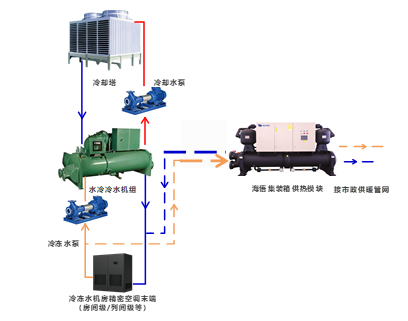
(1) Waste heat utilization of the air conditioning system of the chilled water computer room
The refrigeration process of the air conditioning system of the chilled water room is as follows: the chilled water pump brings the heat in the machine room into the cold evaporator through the water circulation, the compressor transfers the heat absorbed by the evaporator to the condenser under the electric drive, the cooling water pump pushes the water circulation to exchange the heat of the condenser and bring it to the cooling tower, and the cooling tower dissipates the heat in the circulating water to the outdoor environment through forced heat exchange through direct or indirect means. And so on.
The air conditioning system of the chilled water machine room is usually less energy efficient throughout the year, and generally adopts the waste heat recovery of the chilled water side, and the system principle is as follows:

Waste heat recovery mainly occurs in winter, through the waste heat recovery unit for heat recovery, and then heats the surrounding buildings.
(2) Waste heat recovery from the return air of the AHU air conditioning system room
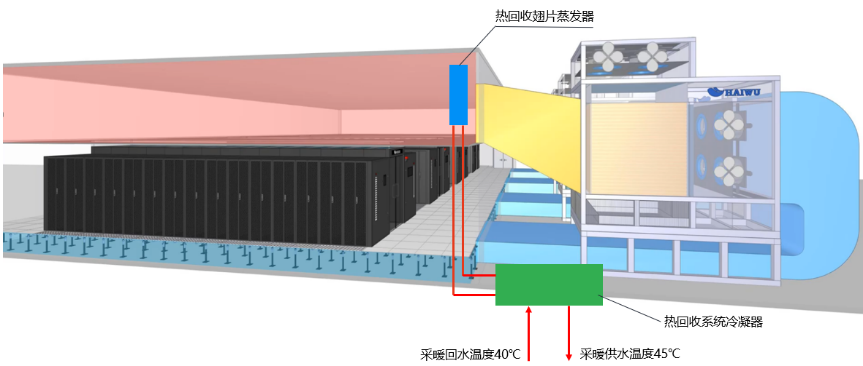
AHU air conditioning system is a temperature control method widely used by large data center computer rooms, especially in the northern region, which can make good use of the natural cooling source and greatly reduce the PUE of year-round operation. The rest of the heat recovery principles are as follows:

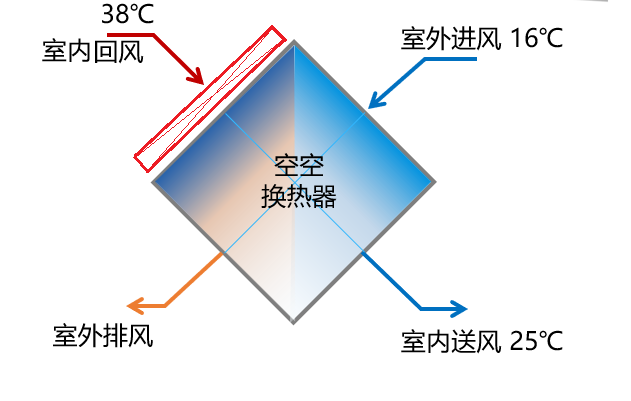
The 38°C hot air from the computer room flows through the evaporator of the heat pump unit added for waste heat recovery, and the temperature is reduced to 26~28°C, and the airflow principle is as follows:

Here (the return air side of the heat exchange core of the AHU unit) has a higher heat grade and the best recovery effect. Then, the air-air heat exchanger in the AHU unit is exchanged with the outdoor air, and the AHU can automatically adjust the outdoor cold air entering the air-air heat exchanger according to the indoor return air temperature.
According to the calculation of the operating parameters of Haiwu AHU products, the heat recovery method only needs to install a fin evaporator in the return air cavity of the computer room, the temperature of the return air into and back heat evaporator is 38 °C, the temperature of the evaporator is 26~28 °C, and the usable temperature can reach more than 10 °C, and the maximum wind resistance of the fin is only about 40 Pa. The total power consumption of AHU fans increased by about 0.85kW, but the operating COP of Haiwu waste heat recovery heat pump under this condition can reach more than 6.31, so that the unit energy consumption of 45°C hot water in all seasons can be reduced to less than 1/6 of traditional electric heating equipment.
(3) Heat recovery of Haiwu PHU all-weather energy-saving unit
PHU units were born under the pressure of the policy of "strict control of PUE and WUE", and the development concept has its own genes of saving, efficiency and environmental friendliness. Among them, the PHU model with heat recovery produced by Haiwu is a new "energy technology and information technology integration product" launched in 2022, which is to promote the development of the industry in the right direction with the goal of "building a green and low-carbon data center".
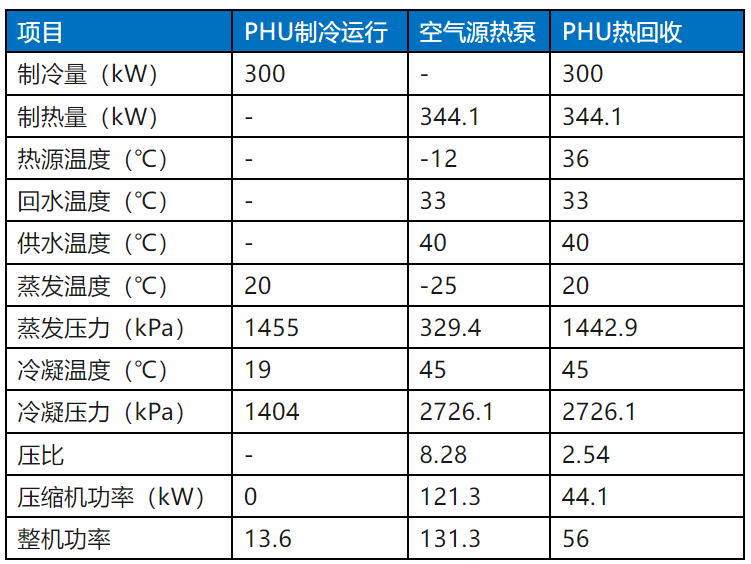
In the winter heating season, Haiwu PHU heat recovery unit can maintain a higher evaporation temperature, use a small pressure ratio compressor, produce heat energy with extreme efficiency, and the heating energy efficiency of the whole machine is significantly improved compared with the air source heat pump unit, which can be explored from the following comparison table:

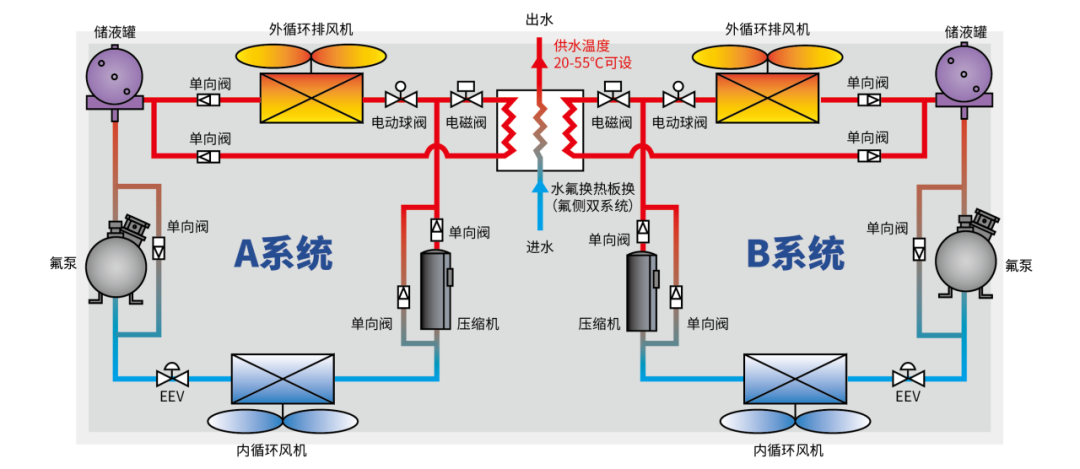
Integrate data center cooling and office area heating to maximize the comprehensive utilization of energy. Its heat recovery principle is as follows:
A heat recovery module (hydrofluorine heat exchange plate replacement) is connected in parallel on the compressor exhaust pipeline, and the heat flow control is controlled by the solenoid valve, the exhaust heat is recovered, and the heating hot water is provided. The heat supply of the whole machine is adjusted by solenoid valve and electric ball valve. The A/B system is graded to cut in/out of the heat recovery condition to avoid violent fluctuations in water temperature.
 (4) Waste heat recovery in liquid-cooled data center schemes
The common characteristics of the three typical data center waste heat recovery technologies shown above are: the proportion of waste heat recovery and utilization in the total annual heat discharge is still very low, and the form of heat utilization is low-temperature hot water, and the use is also limited to washing, heating, breeding, printing and dyeing...... and other smaller fields. Due to the extremely limited transmission radius of low-temperature hot water, it is generally limited by the pipe network and pumping costs, and can only cover within 2-3 kilometers, and the location of the data center has special needs, and there is a high probability that there is a lack of suitable heat users in the surrounding area, resulting in the outreach of both supply and demand.
For example, in the cold plate liquid cooling scheme, the usual outlet water temperature of cold plate liquid cooling is up to 45°C, and the water source heat pump unit is directly added to the outlet pipe of the cold plate to produce hot water at a higher temperature, but the efficiency of this scheme for heat utilization is still not high. If the temperature of the chip is considered whether the liquid-cooled cold plate outlet temperature can be increased to 65°C, or even higher, usually the maximum temperature that can withstand the inside of the chip does not exceed 80°C, and if the outlet temperature of the cold plate can be raised to 65°C, which is more useful for direct use of waste heat for heat recovery. The same is true for immersion liquid cooling, which is more valuable for heat recovery if the temperature of the immersion liquid can be increased.
In short, the waste heat recovery of the data center is still in the exploration stage of the entire industry, and the current heating object is relatively single, and there is not much cooperation with related industries, the scale needs to be further expanded, the relevant technology needs to be further improved, and the heat energy utilization rate needs to be further improved. In this area, data center development is nowhere near what was expected. Where is the heat of the data center? It is worth considering and researching for all our data center practitioners, hoping to do more for the "dual carbon" strategy in terms of waste heat recovery.
Related Newsmore