Under the trend of "dual carbon", how to build a zero-carbon data center should focus on "where does the electricity come from?" Where is it hot?" (2)
Publication Date:2024-12-16
Share to
 2. Utilization of natural cold source:
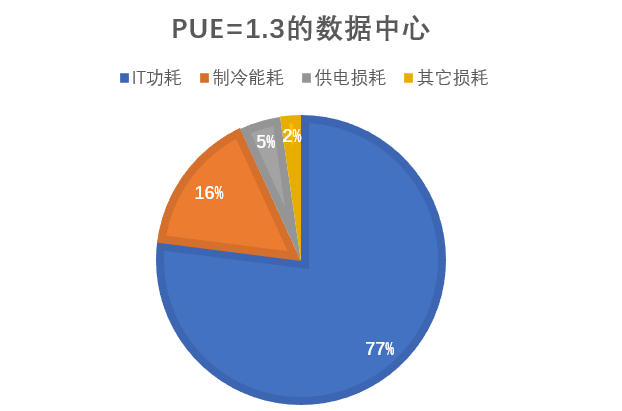
For example, in a data center with a PUE of 1.3, the cooling energy consumption accounts for about 16%, and the power supply and other losses account for about 7%, the proportion is as follows:

The key to whether the refrigeration system can save energy is whether it can effectively use the natural cooling source, and making full use of the natural cooling source is also the most direct solution to reduce cooling energy consumption and reduce cooling carbon emissions. For example, the annual average temperature of Ulanqab is 5°C~7°C, the annual average temperature of Ningxia Zhongwei is 4°C~18°C, the annual average temperature of Qingyang, Gansu Province is 5°C~13°C, the annual average temperature of Yangquan in Shanxi is 6°C~18°C, and the annual average temperature in Zhangjiakou is 4°C~16°C. The average annual temperature in these areas is more suitable for building data centers, so the "East Data and West Computing" data center cluster prefers the above areas. In addition to the climate, you can also consider places with unique water resources, such as the Three Gorges Data Center Cluster in Hubei Province, which uses the electricity of the Three Gorges to provide computing power and the water resources of the Three Gorges to provide cooling of air conditioners. Data center clusters like this also include the Dongjianghu data center cluster in Binzhou City, Hunan Province, which also uses high-quality water resources downstream of Dongjianghu Dam as a cooling solution to reduce PUE.
At present, the main natural cold source utilization schemes in data centers are as follows:
 (1) Indirect evaporative natural cooling unit (AHU) scheme
Indirect evaporative cooling energy-saving unit is an equipment that makes full use of the natural cooling source of the atmosphere to achieve heat dissipation in the data room through the heat exchanger of the hot core (air-air heat exchanger), and the indoor/outdoor air can be transferred without mixing and exchanging, minimizing the use time of mechanical refrigeration, so as to achieve energy saving, low-carbon and environmental protection. At the same time, the AHU unit uses the principle of water evaporation and heat absorption on the outdoor side to spray water (mist) on the outdoor air, further reducing the temperature of the outdoor air (lower than the outdoor ambient temperature), thereby extending the utilization time of the outdoor natural cooling source and achieving the purpose of energy conservation and consumption reduction. It is usually deployed on the roof or side of the data center and is ideal for new construction, renovation of large, medium and large data centers.
The AHU indirect evaporative cooling unit scheme is an integral structure and the system is simple. Compared with the traditional water-cooled chilled water system, this unit scheme integrates cold source equipment, transmission and distribution equipment, unfinished equipment, and automatic control system, which is very convenient for later maintenance. The second feature is flexible deployment and shortened construction cycle. The third feature is water and electricity saving, which can reduce operating costs. The unit solution can make full use of the outdoor natural cooling source, reduce the compressor start time, and the operating modes are divided into dry mode, wet mode and mixed mode. In dry mode and wet mode, the compressor does not turn on. In mixed mode, the compressor is partially turned on. Run dry mode when the temperature is relatively low in winter, and there is no need to spray water when running dry mode. The WUE of the traditional chilled water system is between 1.8~2.4 and the WUE of the AHU system is between 0.3~0.8.
(2) Fluorine pump series natural cooling air conditioners
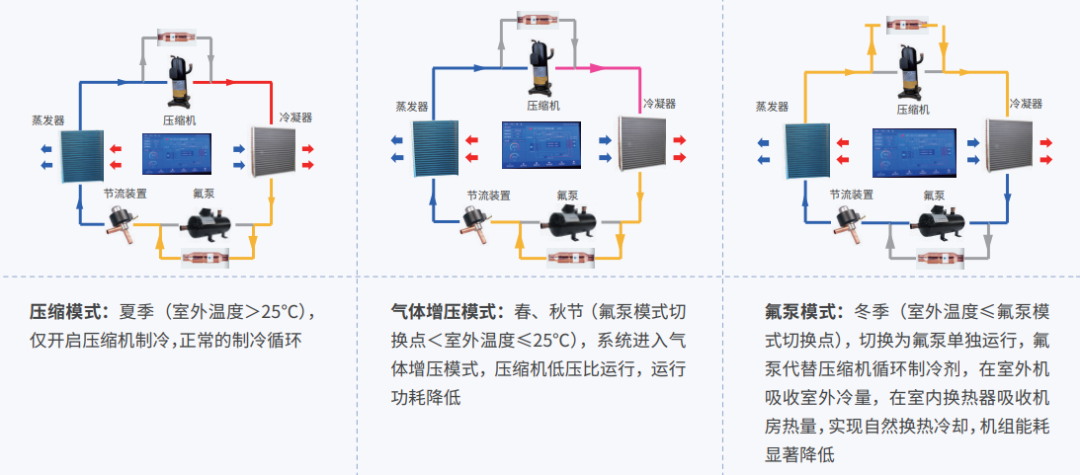
The development of fluorine pump technology has been more than ten years, and the application of fluorine pump technology in data centers is a relatively common technology. The current fluorine pump air conditioning system includes: fluorine pump air conditioner, magnetic levitation phase change multi-unit air conditioner, PHU integral fluorine pump unit, fluorine pump multi-unit air conditioner and other main forms. No matter what form of fluorine pump air conditioner, its basic principle is similar, the fluorine pump system uses the refrigeration compressor to run cold, in the spring and autumn transition season to use the fluorine pump and compressor "mixed mode" operation, and the fluorine pump natural cooling mode is turned on in winter to ensure the safe and reliable operation of the air conditioner in the machine room throughout the year. The biggest advantage of fluorine pump series air conditioners is that they use natural cooling sources, and can be applied to drought and water shortage scenarios.
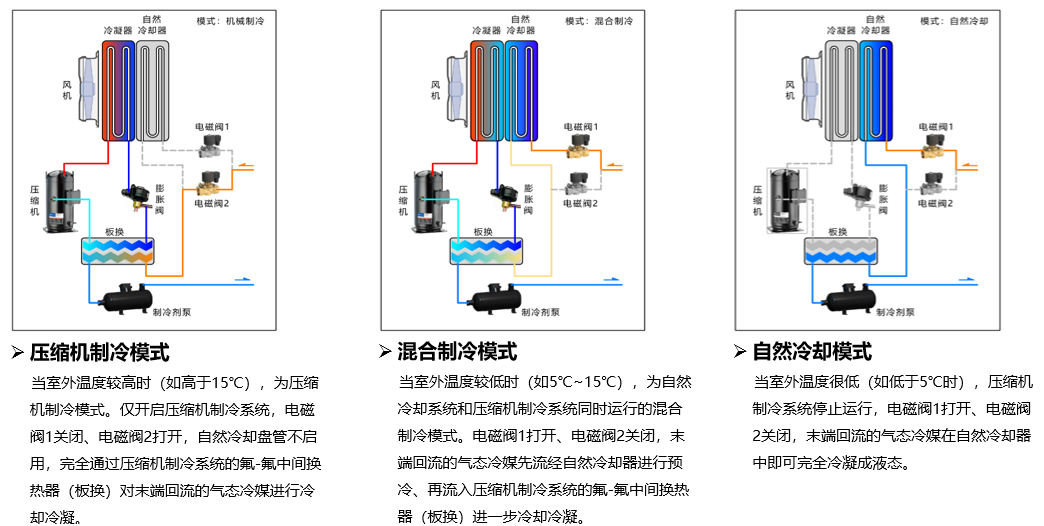
At present, the most mature product in fluorine pump technology is the gas-boosted fluorine pump unit, which is designed for indoor and outdoor units separately, with flexible configuration and suitable for data center scenarios of various sizes. The fluorine pump unit system has three operating modes and makes the most of the outdoor natural cooling source, such as Haiwu's fluorine pump unit, which operates as follows:

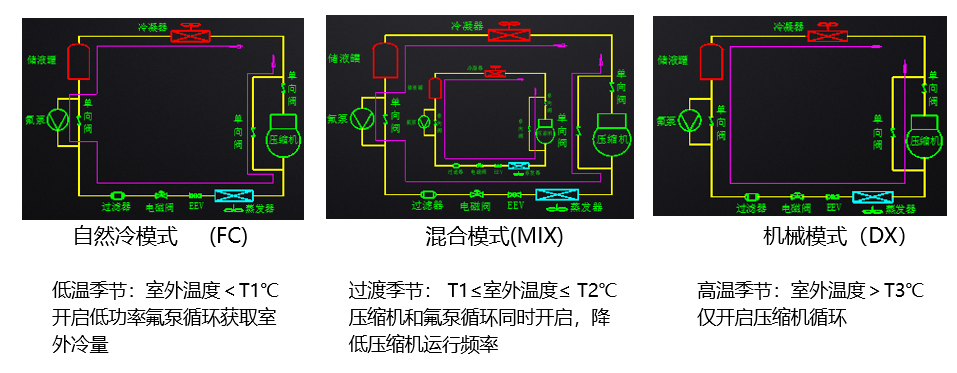
In addition to split fluorine pump units, in recent years, integral fluorine pump unit solutions (PHUs) have emerged, which are cooling solutions for large-scale data center scenarios. PHU integral fluorine pump air conditioning unit is an integrated equipment that makes full use of natural cooling sources through low-power fluorine pumps to realize data center cooling, and also has three operating modes, which can maximize the energy efficiency ratio of the refrigeration system by automatically switching the operating mode by monitoring the outdoor ambient temperature. For example, the PHU unit operation mode of Haiwu is as follows:

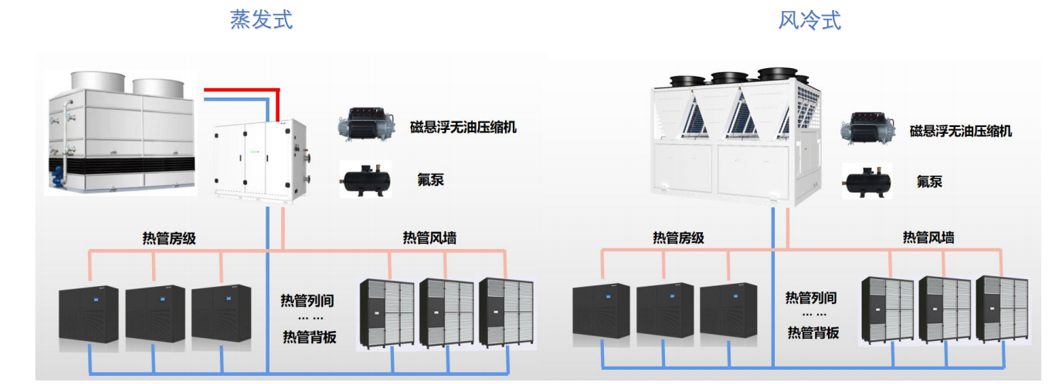
In addition to split fluorine pumps and integral fluorine pump PHUs, for large-scale data center scenarios and scenarios with extremely high requirements for PUE (e.g., PUE≤1.2), the magnetic levitation phase change multi-connection system can be used, which mainly applies magnetic levitation frequency conversion technology, evaporative condenser technology, frequency conversion fluorine pump technology, terminal multi-connection technology, etc. At present, the main cooling forms are magnetic levitation evaporative multiple system and magnetic levitation air-cooled multiple system.

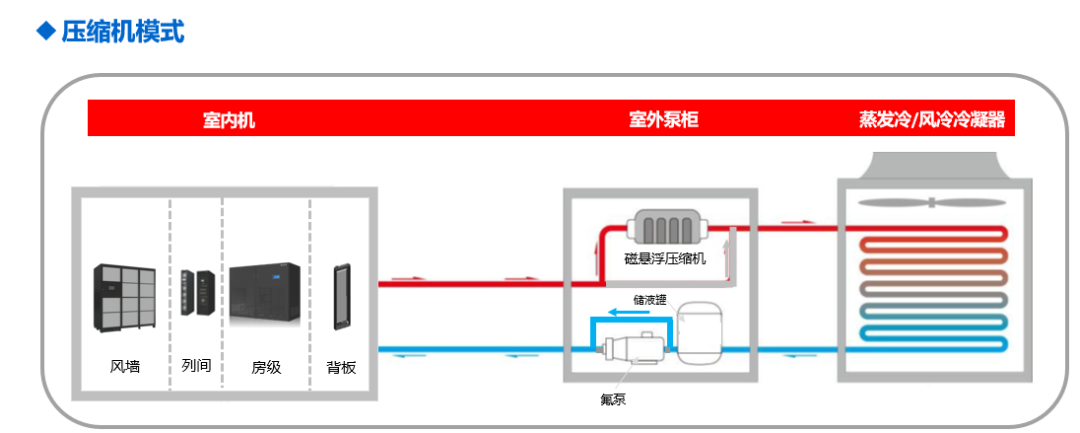
The magnetic levitation phase change multiplex system also has three operating modes, such as the Haiwu magnetic levitation phase change multiplex system, and its operating principle is as follows:

  • When the outdoor temperature is high in summer, turn on the pure compressor mode to ensure that the indoor return air temperature meets the requirements of the computer room.
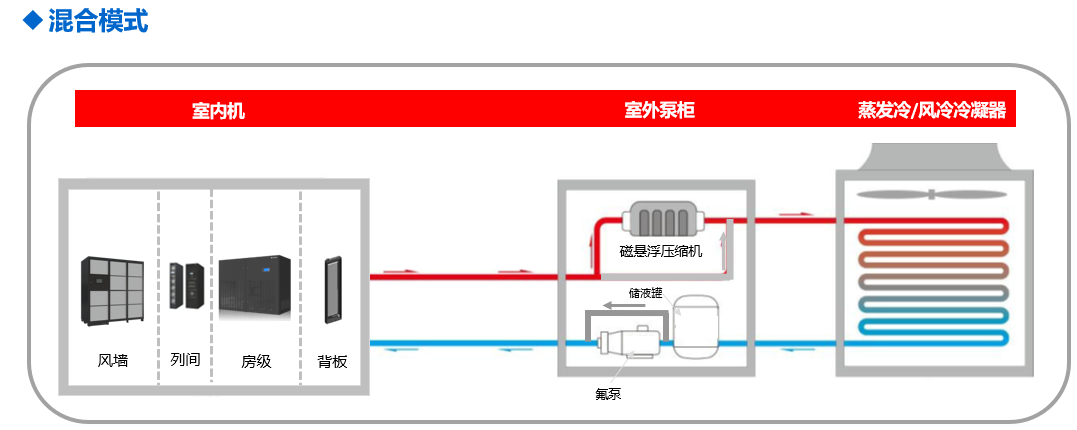
     

  • During the transition season (the season that alternates between winter and summer, usually spring and autumn are the transition seasons), the pressure pump mixing mode is turned on, and the energy efficiency of the system is significantly improved.
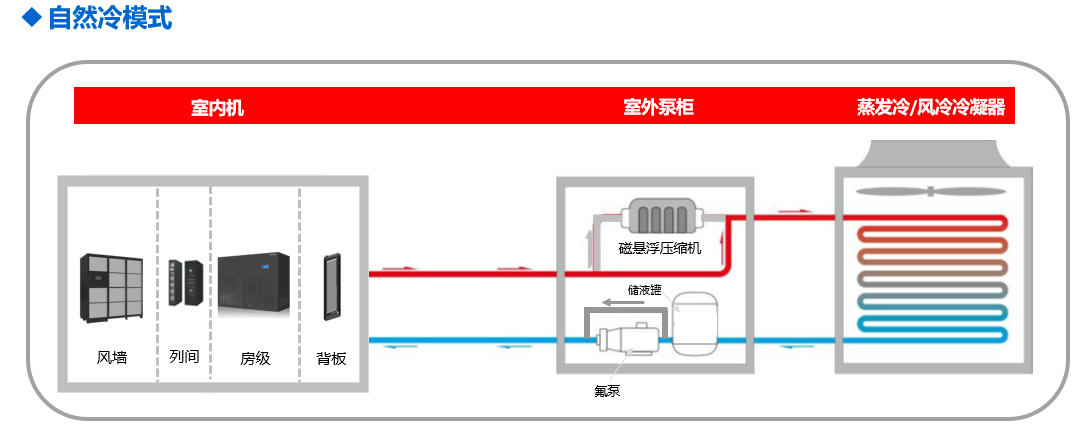
  • When the outdoor temperature is below a certain value, turn on the natural cooling mode of the fluorine pump, at which time the compressor stops working, and the natural cooling source is completely used for cooling, which greatly reduces the energy consumption of data center cooling.
 
 
In addition to the above three forms of fluorine pump system solutions, in order to adapt to the data center scenario with limited installation space of outdoor units, the fluorine pump multi-connection system was born, that is, the fluorine pump system that drags multiple indoor units from one outdoor unit, referred to as fluorine pump multi-connection. The fluorine pump multi-link also has three operating modes, such as Haiwu fluorine pump multi-link, its operation mode is as follows:

(3) Natural cooling of the water source at all times
Using the water sources of natural rivers, rivers, lakes and seas to provide cooling water for the data center, it can cool the water source without consuming electricity, and the water source can be naturally cooled almost most of the time throughout the year, greatly reducing the annual PUE of the data center.
The most critical point of this solution is the location of the data center, which needs to be selected close to the natural water source, by pumping river or lake water, and directly used as cooling water after simple filtration, because the temperature of river water and lake water is usually more than ten degrees Celsius, which is much lower than the air temperature, and the temperature fluctuation in the four seasons is very small, which can effectively take away the heat generated by the server. The specific implementation method is to pump up the river or lake water and filter it, and then introduce it into the cooling water pipeline of the data center, and carry out secondary heat exchange through the plate replacement and the data center air conditioning chilled water, the return water temperature of the chilled water is usually 21 °C, and after the plate replacement, it is cooled to 15 °C to cool down the air conditioner. After the temperature of the lake water is changed by the plate, it is discharged into the river, so as to transfer the heat of servers and other equipment to the river water to achieve the purpose of cooling. When designing the scheme, it is necessary to consider factors such as water quality, flow rate, and temperature of the water source to ensure the cooling effect and equipment safety.
The more famous data center with lake water cooling is the Alibaba Hangzhou Qiandao Lake Data Center, which uses deep lake water, and there are two lake water processors outside the data center, which draw water from a depth of 35 meters below the lake surface through sealed pipes, and the water temperature is basically maintained at about 10 degrees. After the buffer tank enters the lake water processor, and then enters the data center, through the board exchange and frozen water for heat exchange to help the server cool down, and then flows through the 2.5-kilometer Qingxi New Town Central Axis Creek, which is presented as an urban landscape, and finally flows back to Qiandao Lake. The data center achieved an average annual PUE of 1.3.
The more famous case of using Yangtze River water cooling is the Dongjianghu data center in Zixing City, Hunan Province. The Dongjiang Lake Data Center uses the river water downstream of the Dongjiang Lake Reservoir dam as a natural cooling source, the river water temperature downstream of the dam is 8~13 °C all year round, and the river flow is stable and the water quality reaches the national first-class standard. After heat exchange, the river water is discharged downstream through a closed pipe, and the whole process does not consume water resources and does not affect the water quality of the river. This cooling method can reduce the energy consumption of data centers, requiring only one-fifth of the energy consumption compared to traditional cooling methods to ensure the normal operation of the facility. Dongjianghu data center is completely cooled by river water sources for 99% of the year, and almost no chillers are started throughout the year. The river water is cooled at full time, and the average annual PUE is 1.15.
Related Newsmore