


Data Center Architectural Design
4.1 Layout
4.1.1 Installment requirements
The graphic design of the data center should also be planned in phases according to the owner's operational needs, such as by floor or computer room. The owner of the same data center building may lease to N tenants, but each lessee has different requirements for data cabinets due to different business needs.
4.1.2 Rack size and spacing
Among them, the conventional size of the rack (width mm× depth mm× height mm) IT equipment: 600×1200×2200;
Transmission equipment: 600×600×2200.
When the length of the racks arranged in rows does not exceed 15m; The rack spacing in the communication room is 1200mm. The width of the main transportation and handling channel in the computer room is 1.5m, and the width of the secondary channel is not less than 1m. The above dimensions are mainly relative to the cabinet of 6KW, but for a single cabinet higher than 6kw, such as 8KW or 10kw, etc., their direct arrangement spacing may be larger, from the original 1.2m to 1.5m or even 1.8m, mainly to meet the ventilation and heat dissipation needs of the cabinet, the higher the power of the single cabinet, the higher the heat generated, so the higher the heat dissipation requirements for the cabinet;
4.1.3 Functional streamline
The flow line of the data center is mainly divided into the operation flow line, the equipment transportation flow line, the computer room visit flow line, each flow line should avoid crossing, the flow line of the computer room is mainly designed around the data computer room, among them, the high-voltage computer room, the boundary room, the parallel machine room, the refrigeration station, the ECC monitoring room, the communication computer room, etc. are mainly arranged in the first floor, and the second floor and above are arranged according to the layout of the data computer room, the corresponding low-voltage computer room, battery room, UPS room, etc.;
4.1.4 Fire prevention and energy saving
Data center is generally based on industrial buildings or civil buildings as the main declaration type, whether industrial or civil use is mainly based on the type of land use, general industrial land, data center buildings are characterized according to Class C factories, such as multi-functional land or other types of land, data center buildings are characterized according to civil buildings; For specific fire protection requirements, it can be characterized according to whether the data center itself is a civil building or an industrial building, and you can refer to the fire protection chapters of the Code for Building Design GB50016-2014 and other relevant fire prevention chapters for further design. For the energy conservation of the data center, some places do not have energy conservation requirements, some places declare that need energy conservation calculations, energy conservation special articles and other content, the specific application of the local government review functional department requirements shall prevail, energy conservation is also similar to fire prevention, the specific data center is to industrial buildings or civil buildings to declare, the energy conservation specifications are different, of which the energy conservation of industrial buildings is based on the "Unified Standard for Energy Conservation Design of Industrial Buildings" GB51245-2017, and the energy conservation of civil buildings is based on the "Energy Conservation Design Standards for Public Buildings" GB50189-2015 and local norms shall prevail.
4.2 Vertical section design
The profile height of the data center generally needs to be combined with the equipment size in the specific HVAC technical requirements, the general common height is 5m, 5.5m, 6m, some of which are less than 5m in the project design, but the specific project implementation due to the different size of the equipment manufacturer used, the building height is also different, if the owner has a determined equipment manufacturer, should meet the equipment requirements as much as possible, and save the civil construction cost of the project with a reasonable floor height. But it is not only possible to save costs as much as possible and not consider the later equipment manufacturer replacement, the civil cost is a drop in the bucket for the cost of mechanical and electrical engineering, or to focus on the mechanical and electrical process needs, colleagues also need to consider the later change needs. The façade design of the data center is generally based on the introduction of industrial style, because the façade window opening requirements of the data center are less, and the impact on electrical rooms such as the computer room is reduced as much as possible. For example, some data centers have no windows on the entire surface, so some fire rescue windows can only be opened in the four corner stairwells, although the fire prevention regulations do not specify whether they can be opened in the stairwell, but from the perspective of the escape streamline, the stairwell is the main escape route after a fire, and the firefighters break the window in the stairwell at the same time, which will definitely cause a flow of people and is not conducive to fire fighting (the actual number of operation and maintenance personnel in the data center is very small, and it can also be implemented).
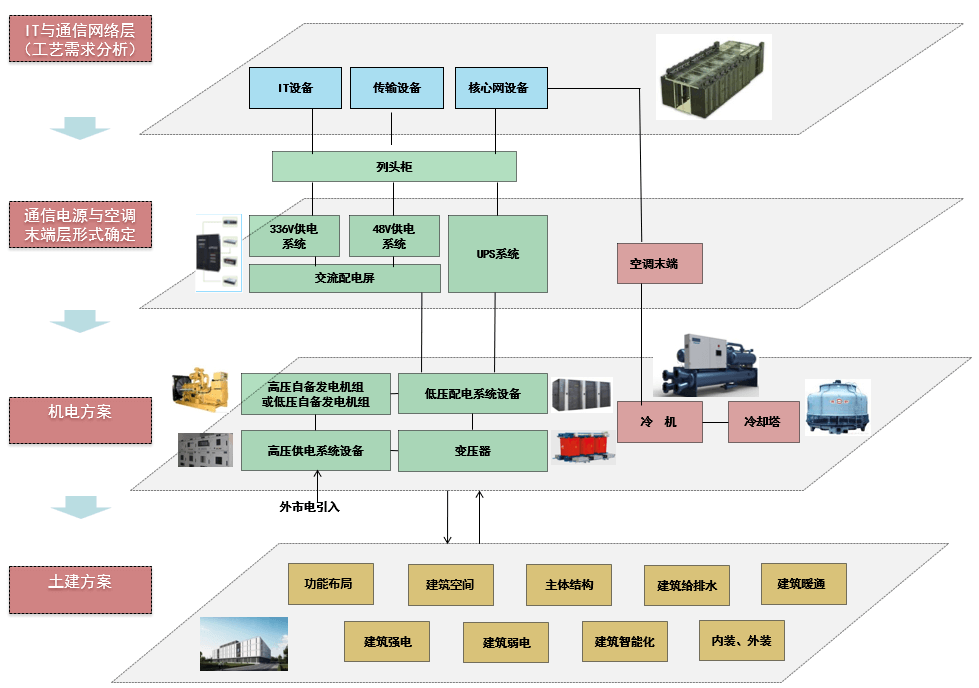
Key points of mechanical and electrical design technology
5.1 Key points of water supply and drainage technology
The influence of water supply and drainage of the data center on the building layout is mainly the cylinder room and high-level water tank room on the ground, and the fire pump room and pool, water replenishment machine room and pool, domestic water pump room and pool underground, etc. Some projects may require reclaimed water treatment room and other needs due to municipal conditions. The layout of the building also has some impact, and the municipal conditions should be confirmed with the owner in this early stage, so as not to affect the time schedule of the entire project. For the fire end water supply and drainage, it is mainly divided into gas extinguishing and spraying areas, which are mainly used in electric rooms, and spraying is mainly used in non-electrical rooms such as corridors. On the whole, water supply and drainage majors have relatively little impact on the layout of buildings in the design of data centers.
5.2 Key points of HVAC technology
For different project requirements in different regions, PUE is also different, PUE index requirements, mainly rely on HVAC technical solutions to meet, different PUE requirements may affect the entire HVAC mechanical and electrical scheme, and at the same time affect the layout of the building, the lower the PUE requirements, the current matching conventional technical solutions are indirect evaporation systems, new magnetic levitation integral fluorine pump systems, liquid cooling technology is also used to meet the high power of a single cabinet, lower energy consumption projects, but liquid cooling technology is currently implemented less by the owner, As the technology becomes more and more mature in the future, it may also be implemented on a large scale. At present, the design field of data centers is mainly indirect evaporation, fluorine pump system, water cooling system, etc., and the terminal mainly uses inter-column air conditioning, air conditioning room, etc. For the building layout, the largest construction area of the HVAC major is the refrigeration station, which generally needs about 1,000 square meters, and some other projects may involve air conditioning in the machine room, fresh air room room, roof cooling tower, smoke exhaust machine room, replenishment machine room, etc.
5.3 Key points of electrical technology
The electrical major of the data center is mainly divided into power supply major, electric lighting major, and weak current intelligent major, which is more detailed than the electrical major of civil buildings, because the data center is mainly in the power supply and distribution area, which is also a more important professional content of the mechanical and electrical major. Weak current intelligence mainly designs some fire alarms, security, intelligence, communication rooms, etc., which have a great impact on the building layout, mainly involving weak current rooms such as communication rooms, ECC, and fire control rooms. For the building layout has a greater impact on power supply and distribution, different data center level requirements are different, A-level data room needs a fault-tolerant 2N system, which requires more building area than B-level and C-level computer rooms, because not only do two sets of system rooms, but also involve diesel generator rooms.
There are three main architectures for A-level data center power supply and distribution systems: 2N system, DR system, and RR system.
The 2N system is mainly composed of 2 power supply and distribution units (in the professional understanding of architecture, that is, two identical power supply and distribution rooms), each unit carries 50% of the load; One unit fails, the other is fully loaded at 100%.
DR system N ≥ composed of 3 power supply and distribution units, each unit bears 66% of the load, and 2 adjacent units supply power, and when one unit fails, the remaining unit continues to supply power to the other unit.
The RR system consists of multiple power supply and distribution units, one of which serves as a backup (also called backup redundancy) for other operating units, and when one operating unit fails, the backup unit continues to supply power to the load through the power switching device.
Among them, the 2N system is the best, not only reliable power supply but also simple system architecture, and domestic data centers also use 2N the most. For the building layout, the power supply and distribution major mainly includes high-voltage computer room, parallel machine room, diesel generator room, low-voltage power distribution room, battery room, etc., which is also the major occupying the most building area in data center design in addition to the data room room.
Conclusion
Data center design is different from civil buildings, no longer based on architecture, data centers tend to be dominated by power supply and supplemented by refrigeration solutions. As an architectural designer, if we want to do a good job in the data center project, we should understand more about the system principle of power supply and distribution and the detailed requirements of each electrical room plan, and at the same time, we should summarize and communicate more about the advantages and disadvantages of new technologies and principles of refrigeration, so as to prepare for the subsequent data center architectural design.


