


Imagine a "tsunami" of traffic from 1.4 billion people shopping, which is a devastating impact on a single data center, making services inaccessible or directly paralyzed. Unless this single data center is large enough regardless of investment and efficiency.
But in real life, this is basically non-existent. In the face of such high-traffic burst access scenarios, commercial data centers generally adopt a multi-DC multi-active architecture to balance massive traffic to ensure that traffic is accessed nearby and diverted from multiple places. In fact, data centers are no longer a new concept.
Now, the data center of "two places and three centers" has become the basic configuration of many enterprises. Many large banks and large enterprises have also begun to lay out multi-location and multi-center structures. With the popularization of this architecture and the cooperation of other related technologies, it is believed that in the near future, it is not a problem to withstand the impact of large traffic of 1.4 billion people shopping.
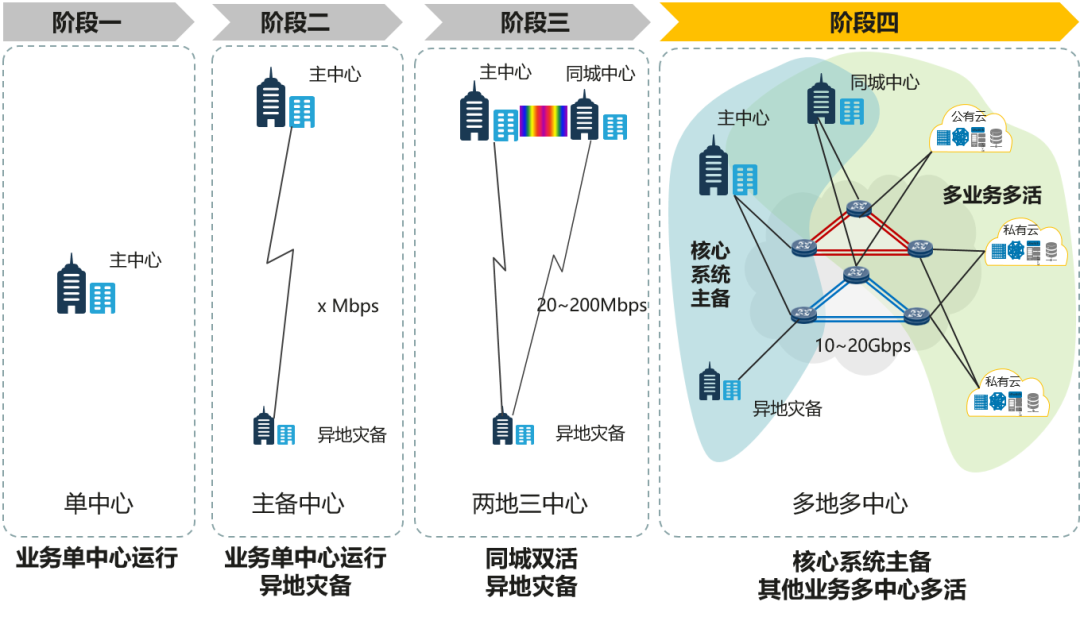
Evolution diagram from single DC to multi-cloud multi-DC architecture
So why are only large banks and large enterprises taking the lead in adopting the multi-location and multi-center model? Because large banks and large enterprises are the pioneers of digital transformation, they are the first to face the impact of massive data. According to data released by the People's Bank of China, on November 11, 2020, the total concurrency of bank online payment business was 109,000 transactions per second, a year-on-year increase of 25.19%. For example, the delay and accuracy of data transmission between DCs are more stringent, and the flexibility of management and operation and maintenance is also very high.
Challenge 1: High data synchronization latency across data centers affects user shopping experience
Assuming that 1.4 billion people are buying the same product at the same time, but the merchant only stocks 10 million pieces, it needs to quickly synchronize the news of the product being sold out to another 1.39 billion people. If it is a standard 70km intra-city data center, the transmission delay across the DC network reaches 1ms, and the traffic regulation of the data center network will fail, resulting in the data to be synchronized must be retransmitted, and the delay experience fed back to the user may be as high as 1~3 seconds.
Huawei's Hyper-Converged Data Center Network NoF+ breaks through the flaw of slow Ethernet ultra-long-distance transmission feedback, which can realize long-distance lossless transmission across data centers. Compared with FC private networks, the throughput IOPS of storage can be increased by up to 93%, and the congestion latency caused by traffic bursts can be reduced by up to 43%.
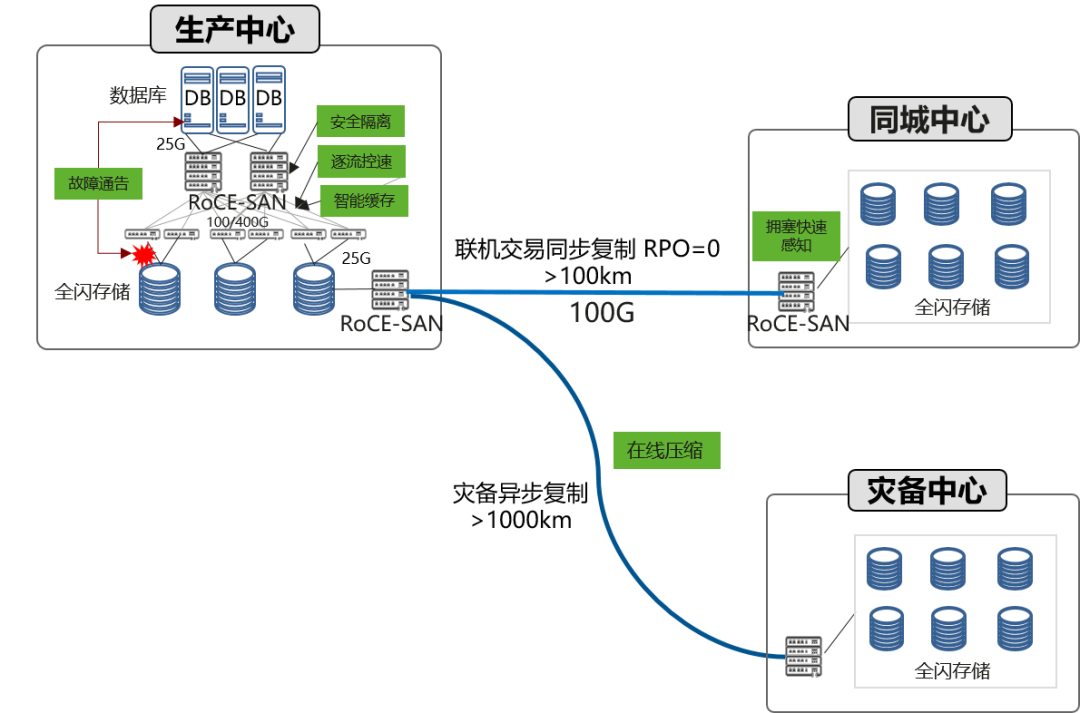
Lossless Ethernet storage network NoF+ overall architecture
Challenge 2: Multi-location and multi-center networks are often heterogeneous networks with multiple vendors, and the efficiency of segment-by-segment deployment is low
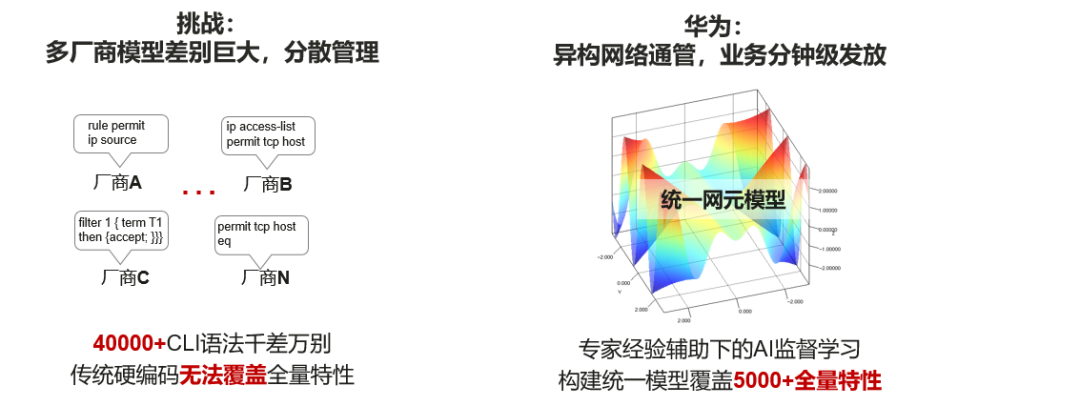
Suppose that in order to support this shopping festival, the mall has specially launched a red envelope grabbing game, which needs to be distributed in data centers across the country, which involves DNS, load balancing, firewalls, switches and other equipment of different data centers, each CLI syntax is very different, and the degree of automation is uneven.
Huawei's hyperconverged data center network is based on iMaster NCE-Fabric, a core component, which can mask network NE differences, model data from multiple vendor networks, achieve undifferentiated visualization and simulation of the entire network, and deploy it with one click to help services go online in minutes.
However, the construction cost of multiple places and centers is very high, and if it wants to support the shopping of 1.4 billion people, even large factories are more than willing and not enough. Therefore, enterprises often put some non-core assets and data on the public cloud to facilitate flexible expansion and scaling. For example, a common page viewed by 1.4 billion people is deployed on the public cloud, and once it enters the payment process, the connection goes to the private cloud. This brings another challenge.
Challenge 3: Multi-cloud/Kunhe cloud services are slow to connect and are prone to errors
Huawei's hyperconverged data center network uses the iMaster NCE MDC component to connect to public cloud calls and manage iMaster NCE-Fabric on the other hand, extending single network management to public clouds, private clouds, industry clouds, and other networks for unified control and automation, and achieving cross-cloud service network provisioning in seconds.
Although the assumption that 1.4 billion people shop at the same time is an extreme example of a big opening, with the deepening of digital transformation, users from all walks of life are migrating online, and the amount and complexity of data faced by data centers are increasing exponentially. Ensuring the efficiency and quality of data transmission and ensuring the agility of services are the core demands of the new generation of data center networks.


