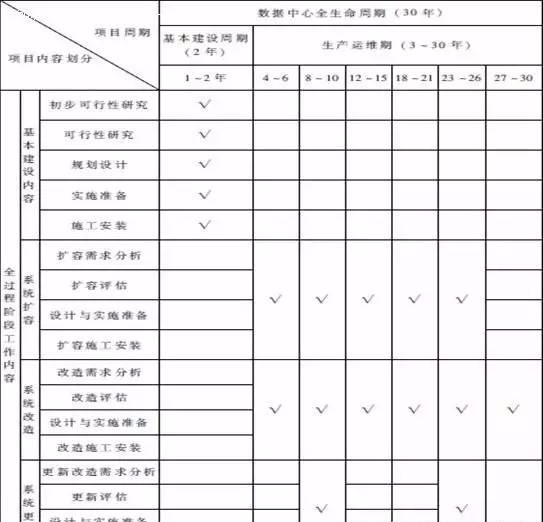
1. Stage division of the whole life cycle of the data center
The whole life cycle of the data center refers to the whole process from the generation of construction intention to the end of the economic life of the data center. It is usually divided into the decision-making period, the implementation period and the production and operation and maintenance period, and each period is divided into several stages. The details are shown in Figure 2-1.
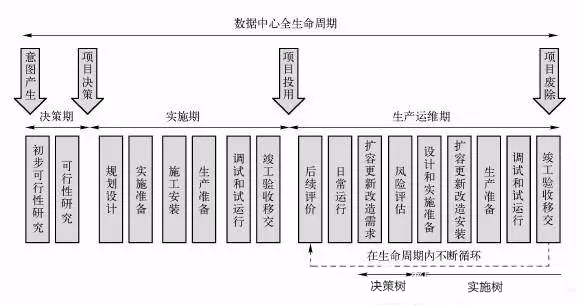
Figure 2-1 The entire life cycle of a data center
(1) The decision-making period of a data center project refers to the whole process from the generation of the intention of the construction project to the scientific demonstration of the construction project and the decision-making of the project. Specifically, it includes the process of conducting research and analysis on the business positioning, construction scale, construction standards, market prospects, etc. of the project, and making judgments and decisions on the feasibility study of the proposed project.
(2) The implementation period of the data center project refers to the whole process from the planning and design of the project to the completion of the project capital construction and the completion acceptance and handover.
(3) The production, operation and maintenance period of a data center project refers to the whole process from the completion of the project capital construction to the end of the project's economic life.
2. Data center capital construction cycle
A large data center is a specialized building, which is different from ordinary buildings, and its construction standards are much higher than those of ordinary office buildings, commercial buildings, factories, etc. Especially in the whole life cycle of the project, the investment in the mechanical and electrical part is basically 3~4 times that of the civil engineering investment, and the project investment is very huge. Therefore, data center construction projects have the characteristics of long payback period and large technological changes. If a one-time investment is used to complete the entire data center construction project, it will inevitably lead to long-term occupation of funds and greatly increase the cost of capital, which is undoubtedly a very uneconomical approach. In particular, the construction mode of commercial data center construction projects is closely related to market sales, business needs, and technological development. Therefore, data center construction projects must consider the economy of their whole life cycle. It is usually implemented in phases and stages to achieve the goal of completing the capital construction in the early stage and building it as needed in the later stage. This makes data center construction projects longer and more complex throughout their life cycle, and not only that, but also in the subsequent production and operation period, they will continue to carry out expansion, renewal and transformation.
In order to better distinguish between the various construction stages, we have introduced the concept of "data center capital construction cycle", which refers to the period from the start of the project to the completion of the project capital construction and the meeting of pre-planning requirements, until the data center can be provided for normal operation and use. This is the content of the decision-making period and implementation period of the construction project, excluding the expansion, renewal and transformation of the later data center production and operation period.
According to the actual situation of project construction, the basic construction cycle of data centers is usually subdivided into the decision-making stage, implementation preparation stage, implementation stage, and commissioning completion stage, as shown in Figure 2-2. The main work content of each stage is as follows:
(1) Decision-making stage: including the preliminary feasibility study of the data center project and the feasibility study, to determine the investment estimate of the data center.
(2) Implementation preparation stage: including the planning, design and implementation preparation of the data center construction project.
(3) Implementation stage: including equipment procurement and supply, construction and installation and production preparation for the data center.
(4) Commissioning and completion stage: including commissioning, trial operation and completion acceptance and handover of data center equipment.
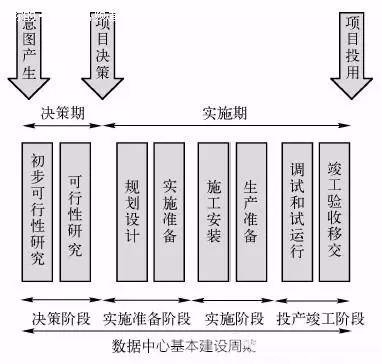
图2-2 数据中心基本建设周期
3. Data center production and operation and maintenance period
The production and operation and maintenance period of data center construction projects refers to the whole process from the delivery of the project to the end of the economic life of the project, that is, the cycle of the project to carry out production and operation and maintenance activities, recover the investment, and achieve the expected investment goals. Due to the operation and maintenance characteristics of the data center itself, its production and operation and maintenance period is very different from that of ordinary projects. It is mainly reflected in the fact that in order to better meet the changing business needs of enterprises and maintain the sustainable development of data centers, there will be more frequent project activities such as expansion, expansion and renewal during the operation and maintenance period of data centers. Therefore, the work content of the production and operation and maintenance period of the data center project mainly includes: the evaluation of the follow-up project and the expansion, renewal, and transformation of the data center in the later stage, of which the expansion, renewal and transformation of the data center include two stages: the decision-making period and the implementation period, and this process will continue to cycle during the entire production and operation and maintenance period until the data center cannot meet the use requirements, that is, the economic life of the data center ends. The production and maintenance period of the data center is shown in Figure 2-3.
2.2.2. Predictive analysis of the full life cycle of data centers
How many years should the data center life cycle indicator be determined? This question has been bothering CIOs and there is no answer yet. However, life cycle indicators are of great significance, which is not only related to the financial analysis and economic analysis of investment and construction projects, but also related to the decision-making of investment and construction projects. For commercial data centers, payback period and return on investment are key issues in investment decision-making. If there is no comprehensive understanding and understanding of data center life cycle indicators in the project decision-making stage, it will be impossible to analyze the payback period and return on investment, and then it will not be possible to conduct accurate and scientific financial analysis and economic analysis, which will ultimately lead to mistakes in project decision-making. Therefore, predictive analytics for the entire data center lifecycle becomes particularly important.
There are many factors that affect the entire life cycle of a data center, such as the peripheral building, the main internal electromechanical equipment, and IT equipment. For details, you can refer to the relevant provisions on the depreciation period of fixed assets in the financial system, and combine the operation and maintenance characteristics of the data center business. The depreciation period of fixed assets is shown in Table 2-1.
Table 2-1 Reference list of depreciation years of fixed assets
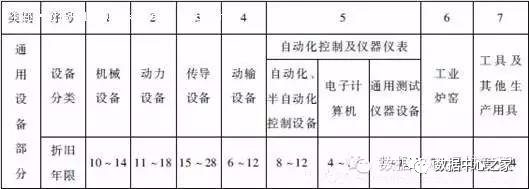
According to the operation and maintenance characteristics of data center business, the life cycle of data center is mainly determined by comprehensive factors such as the depreciation life of buildings and main equipment itself, IT equipment and new technology development, customer demand and economy.
First of all, from the perspective of building types, the space of data center production and operation belongs to the production building, and the maximum economic life is about 30~40 years, but can the load-bearing and spatial structure of the building meet the needs of data center technology development in the next 30~40 years? The construction standards of data centers will be higher than those of ordinary buildings, but as a specialized and commercial building, based on the experience of many data center operators in the United States, Japan and other countries, it is a reasonable value to use 30 years as a data center life cycle indicator. During this life cycle, none of the requirements for its architectural and structural changes are very large. If the initial planning and design is carried out according to high standards, such as data center buildings established according to TIA-942 Tier 4 standards, there will be basically no risk in the building structure, including floor height, floor slab load-bearing, functional space, etc. during the life cycle.
Secondly, the main service object of the data center is IT systems. In its 30~40 year life cycle, the IT system has changed very much, and the IT system may have gone through multiple life cycles. The change of IT technology has also led to the continuous change of critical infrastructure technology, so it is important to pay attention to the life cycle of these critical infrastructures. The life cycle of these critical infrastructures is determined by many factors such as their depreciation years, new technology developments, IT technology needs, and economics. The development of new technologies is the main reason for the shortening of the cycle of data center critical infrastructure upgrading, which will depend on the feasibility, economy and support of the new technology for the entire business system. Judging from the experience of foreign operators for many years, the economic life of critical infrastructure is about 10~15 years, and it is usually necessary to start the next round of upgrading after 3~5 years of normal operation. But it can be seen that this upgrading process is not completed all at once, it is usually slowly replaced from the peripheral system, and then slowly realized in the process of 4~5 years. This requires that the requirements of later business growth and how to update and replace the capacity after the capacity reaches the limit are fully considered in the initial design and planning of the entire system capacity, see Table 2-2.
Table 2-2 Summary table of data center life cycle